Bots that do the work on your computer.
MOSS is an app for your computer where you talk to AI bots. Each one has a face, a memory and a job, and gets things done with your files, your commands and the web, asking you first before anything risky.
Not released yet. The first release brings MOSS and MOSS Code to macOS, Windows and Linux together.
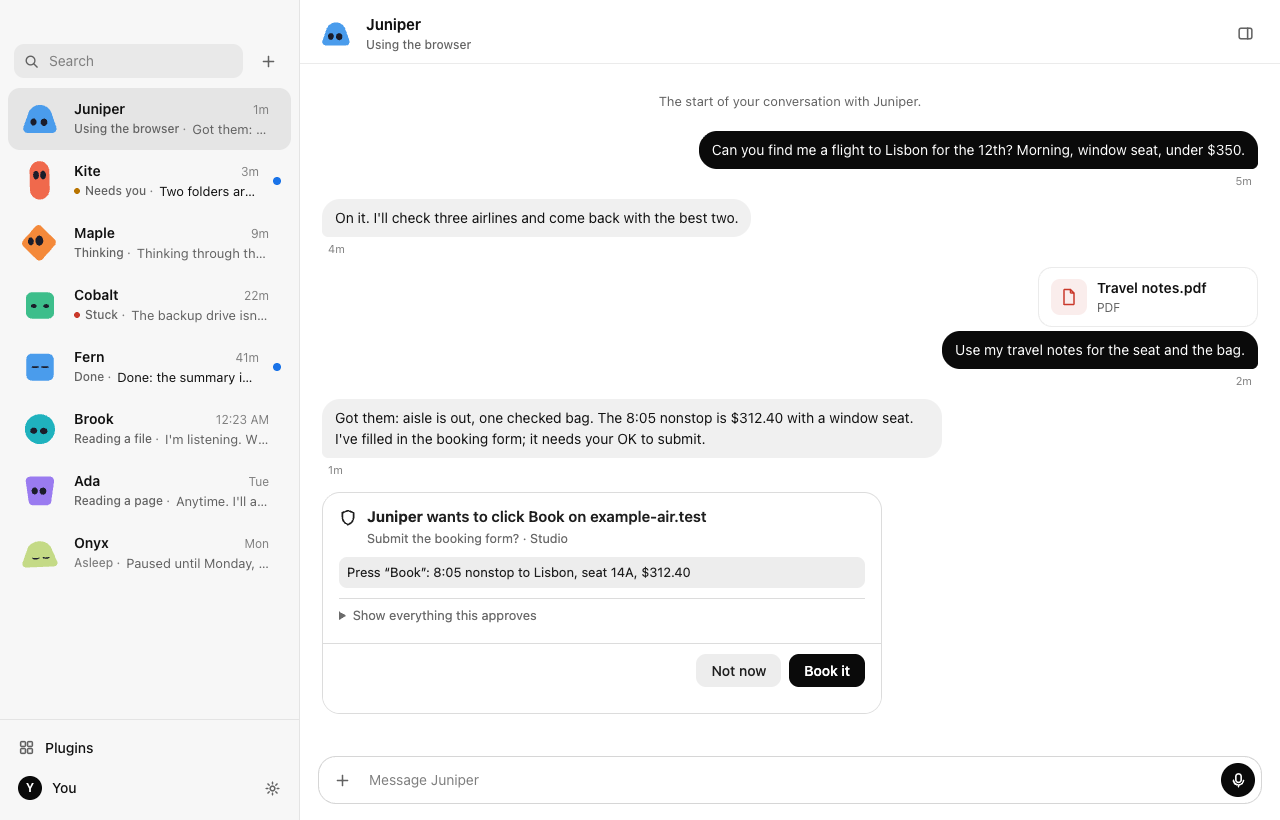
- Juniper1m Using the browserComparing three airlines
- Kite3m Needs youTwo folders are ready to delete Unread
- Maple9m ThinkingPlanning the trip budget
- Cobalt22m StuckThe backup drive isn't connected
- Fern41m DoneThe summary is in your notes Unread
- Brook12:23 Reading a fileGoing through the lease
- OnyxMon AsleepPaused until Monday
Each bot is someone you can talk to
You make a bot by giving it a name. The name makes its face, and the same name always makes the same one. MOSS, the bot you meet first, is the coral one.
One conversation
Like texting a person: one long conversation with each bot. A message from you interrupts whatever it is doing.
Its own memory
Each bot keeps notes in a memory folder of its own, and you can read everything it keeps.
Routines
Ask for something every morning or every Friday and the bot writes itself a routine. Pause one or run it now whenever you like.
A face shows what its bot is doing
- Idle
- Listening
- Thinking
- Working
- Needs you
- Stuck
- Done
- Asleep
The words are always there too, beside every face, and with reduced motion turned on the faces keep still.
Juniper is a sky-blue dome. Every bot called Juniper looks like this.
What a bot can do
Ask it in your own words. It picks the tools.
- Your filesRead them, sort them, write new ones, in the folders you use.
- CommandsRun them on your computer, inside a sandbox.
- The webSearch it and read pages.
- A browser of its ownIt works in the background, and you can watch it in the bot's side panel.
- RoutinesJobs on a schedule, or when a webhook arrives.
- Other bots, coding agentsIt can message your other bots, and hand a coding job to an agent.
- TalkingWith a voice plugin and your own key for it, it speaks its replies and listens while you hold the talk button.
Not in the first release: controlling your screen. It will come later, as a plugin.
It asks before anything risky
When a bot wants to do something its level doesn't let it do alone, it stops and asks you on a card. The card says who wants to do what, and where. Only a real press on its button answers it: a bot can't answer its own card.

Commands run in a sandbox
At the default level a command can write only to the bot's own folders and the temporary folder, and can't reach the network. When it needs more, it asks for that folder on a card.
The card finds you
It shows in the MOSS window when you're there, and on a small island at the top of your screen when you're in another app. When the phone apps are out, it reaches your phone too.
You choose how much it does alone
- Read only
- It can look at things. It changes nothing and runs nothing.
- Ask before every action
- Every change, command or page it opens waits for your OK.
- Ask before risky actionsDefault
- It works on its own inside its sandbox and your ordinary folders. Deleting, buying, and anything MOSS's safety check isn't sure of, ask you first.
- Ask before risky actions, edits allowed
- The same, and it may also change and move files in sensitive places, like the settings files in your home folder, without asking.
- Fully automatic
- It never asks. Changes to MOSS's own settings, levels and plugins still do.
You set the level for each of your computers, in Settings. Changing it asks you on a card first. What each level allows.
MOSS Code: your coding agents, side by side
MOSS Code is the second app. It runs the coding agents you already use, each in a session of its own, and lays them out on one canvas, so you can see what every one of them is doing and open any of them.

The agents you have
Claude Code, Codex, Gemini CLI, Antigravity CLI, Cursor, Copilot, Devin, Grok, DeepSeek Harness, OpenCode, Qwen, Kimi, and MOSS's own coding agent. You install an agent the usual way, and MOSS Code finds it on your computer.
The same cards
Each agent keeps its own sign-in and its own sandbox. When it asks to do something, the request goes through your level and comes to you on the same cards as a bot's.
Bots hand over
A bot in MOSS can give a coding job to an agent. With both apps installed, that job opens in MOSS Code as a session you can watch and steer.
Almost everything is a plugin
Models, tools, voices and coding agents all come as plugins, and so does most of MOSS Code's window. A plugin is just a folder of files.

- Nothing new runs without your OKWhen a plugin arrives, a card says what it is and what it may do, and it waits for you.
- Each tool, your wayOff, on demand, or always on; and when a bot uses it, always allow, ask, or always block.
- Bring what you haveAdd an MCP server, a skill folder or a Claude Code plugin, and MOSS wraps it as a plugin for you.
- Change the windowIn MOSS Code, plugins can restyle and rearrange the window itself. MOSS keeps its own plain window.
Your own model, and what leaves your computer
MOSS doesn't come with a model: you bring one. Sign in to a subscription you already have or paste an API key, from OpenAI, Anthropic, Google, OpenRouter, xAI and many more, or run a model on your own computer with Ollama or LM Studio.

What leaves your computer
- Your model provider gets what you write and what the bot reads to answer you: files, pages, command output, pictures you attach. A few background jobs use it too: titles, a safety check before commands, and, in MOSS Code, passes that read idle sessions to keep its memory and to clear away ones with nothing worth keeping. With a voice set up, what it speaks and what you say to it go to your voice provider.
- Web searches go to Exa, a search company, from the start, with no account or key. Exa gets the words searched for and your IP address. To stop it, switch off the Web search and fetch plugin in MOSS Code, or with
moss plugin disable moss/web. Pages a bot reads are fetched straight from your computer. - Updates come from this project's releases on GitHub. Both apps check when they start and every 4 hours, download a new version on their own and install it when MOSS has nothing running. There is no switch to turn this off. GitHub sees your IP address and which version you have.
- Paired devices find each other through a small WaifuCave service, and learn their own network address from Cloudflare's and Google's public STUN servers. n0's address lookup helps them find each other, and when two can't connect directly, a relay carries their traffic: n0's public relays unless you pick your own. What passes between your devices is encrypted end to end, but a relay sees their IP addresses, which are online and how much they send.
- The time: while your devices are linked, they ask Cloudflare's and Google's public time servers, so they agree on it.
- Webhook routines get the calls that start them through a WaifuCave forwarder, which seals each one for your computers on arrival and holds it at most 7 days.
- Downloads you OK come from where the card says: Claude Code's and Codex's adapters from npm, a plugin from the address you gave. A plugin can then reach what its card said it may.
- Your keys stay on your computer: in the Keychain on macOS, and on Windows and Linux in an encrypted file whose key your system's secret store keeps (or, with no secret store, a key file only you can read).
Each of these in full. MOSS has no analytics, no telemetry and no crash reports. You don't need an account: devices pair with a code. Claude subscriptions can't be used in MOSS; an Anthropic Console sign-in, billed to your API account, can.
On all your computers, and soon your phone
Pair them once
Connect your computers with a code or a QR code, then check that the same four words show on both screens. The link between them is encrypted end to end.
One bot, every computer
A bot can then work on any of them. Its files and commands run on the computer that holds them, under that computer's own level.
Phone apps, being built
MOSS and MOSS Code for iPhone and Android are being built now: your bots, your sessions and your cards in your pocket. They are not out yet.
Open source, on three systems
MOSS's code is open source under the Apache 2.0 license: both apps, the engine and the command line. Read the code, build it yourself, or tell us what's wrong.
| System | Version | Chips |
|---|---|---|
| macOS | 27 or later | Apple silicon |
| Windows | 11 | x64 |
| Linux | Ubuntu 26.04 LTS, current Fedora | x64 and arm64 |
Download
MOSS isn't released yet. The first release brings both apps to macOS, Windows and Linux at the same time. Until then, the code is on GitHub, and the docs say what to expect.
MOSS is for people 13 and older. You need an account or key with a model provider, or a model running on your own computer.
MOSS
The app for your bots.
Not released yet
MOSS Code
The app for your coding agents.
Not released yet
For developers
Both apps are clients of one engine, moss-core: a Bun process that starts at login and holds everything, the bots, the sessions, the plugins, the keys and the settings. The apps, the moss command and the phones talk to it over JSON-RPC on a local socket (a named pipe on Windows), and every client is a view of its event log.
A plugin is a folder with a moss.json. It can bring MCP servers, skills, model providers, coding agents that speak ACP, routine triggers, and in MOSS Code, themes and parts of the window. Plugin code runs in its own worker in a plugin host, apart from the engine, so a broken plugin can't take the engine down.
Write your first plugin, read the docs, or start from the source.
moss plugin new tool hello-tool
moss plugin validate hello-tool
moss plugin dev hello-tool